Quick answer: It's not too late, but November is the time to act. Use the first half of November to review benefits and tax withholding, the second half to adjust savings and plan your giving, and December to finish anything with a December 31 deadline. A few things, like IRA and HSA contributions for 2026, can wait until the April 2027 filing deadline. Every January, we hear the same thing: "I wish I'd done this before the year ended." Many of the most useful tax and savings moves have a hard December 31 deadline. Waiting until the week before New Year's means rushed decisions, closed offices, and missed opportunities. This guide breaks the rest of 2026 into three simple steps, with a section for business owners near the end. Your year-end game plan at a glance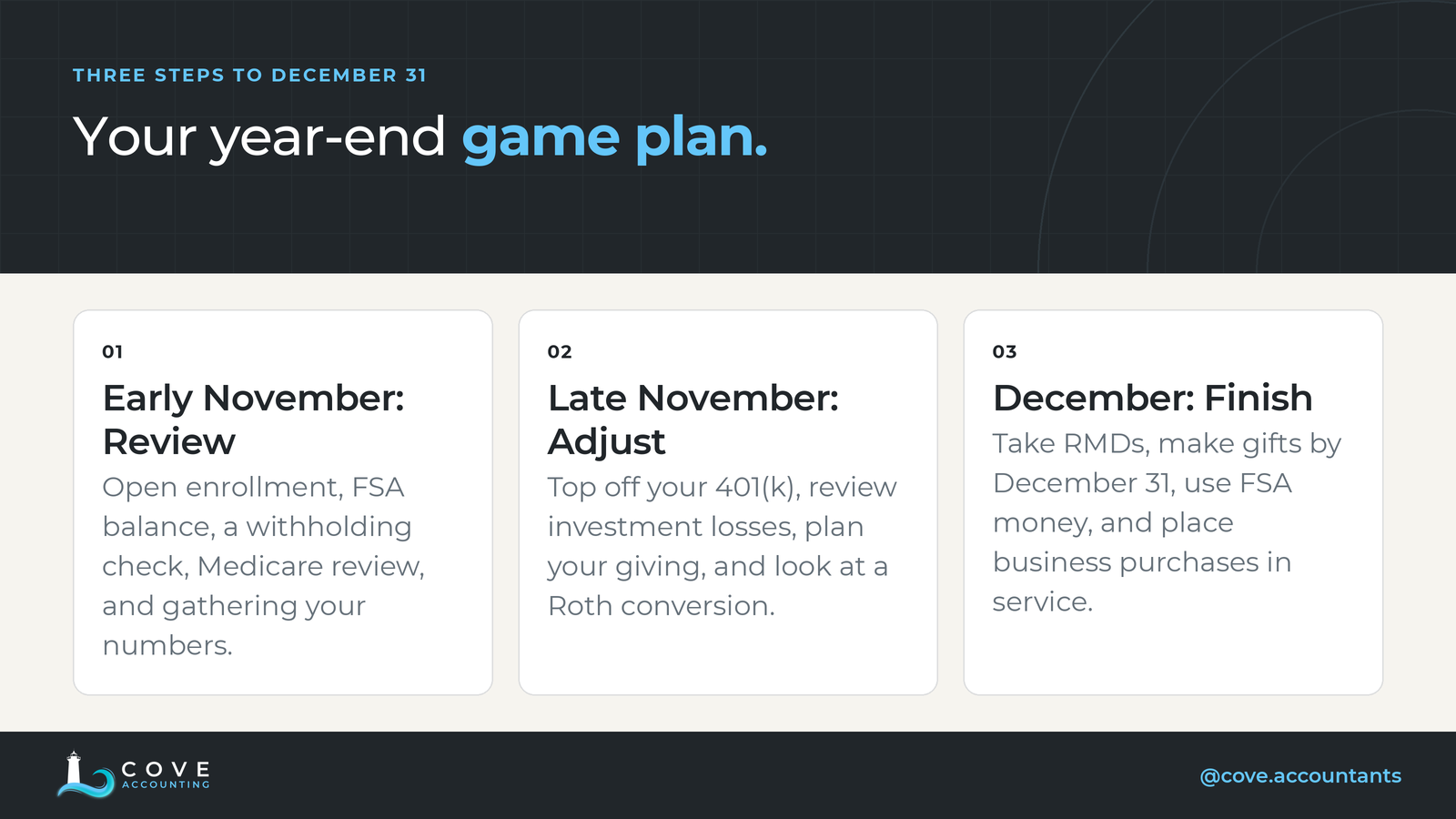
Early November: Review and get organizedWhat should I do in early November to prepare for year-end?Start by taking stock. There are still several weeks to make changes, and most deadlines haven't arrived yet. - Pick your benefits carefully during open enrollment. Compare health plans on total cost (premiums plus deductibles), not just the paycheck deduction. If you're eligible for a Health Savings Account (HSA), it's one of the few accounts that can be tax-free going in, while it grows, and coming out for qualified medical costs.
- Check your FSA balance. Flexible Spending Account money is mostly use-it-or-lose-it. If your employer's plan allows a carryover, the most you can carry from 2026 into 2027 is $680, according to the IRS.
- Run a tax withholding check. Use the IRS Tax Withholding Estimator or your latest pay stub. If you're on track to owe, adjusting your W-4 now spreads the fix over your last few paychecks.
- On Medicare? Review your plan. Medicare Open Enrollment runs October 15 through December 7, and changes take effect January 1. Drug coverage and costs change every year, so compare before you auto-renew.
- Gather your numbers. Pull year-to-date income, retirement contributions, and any big one-time events, like a home sale, job change, or inheritance. These shape every decision that follows.
Late November: Adjust and plan aheadWhat financial moves should I make in late November?The second half of November is for fine-tuning. You know roughly what the year looks like, and there's still time to act. - Top off retirement contributions. If you haven't reached your 401(k) limit for 2026 ($24,500, or more with catch-up contributions), you may be able to raise your contribution for the last few paychecks. Once the IRS announces the 2027 limits, update next year's contribution too.
- Know the new catch-up rule. Beginning in 2026, if your prior-year wages from your employer were over $150,000, any 401(k) catch-up contributions must be made as Roth (after-tax) contributions, according to the IRS. Check that your paycheck reflects this.
- Review investment losses with your tax preparer. Losses you realize can offset gains from this year, and up to $3,000 of other income ($1,500 if married filing separately). Watch the wash sale rule: buying substantially identical securities within 30 days before or after the sale can disallow the loss.
- Plan your charitable giving around the new rule. Beginning with tax year 2026, if you don't itemize, you can deduct up to $1,000 ($2,000 if filing jointly) of cash gifts to qualifying charities, according to the IRS.
- Consider a Roth conversion. If your income is lower than usual this year, converting some traditional IRA money to a Roth could mean paying tax at a lower rate. Run the numbers first, because the converted amount is taxable income for 2026.
December: Beat the deadlinesWhat has to be done by December 31?Some moves must be finished by December 31. Others can wait until you file your 2026 return. Here's the difference: | Task | Deadline |
|---|
| 401(k), 403(b), and 457 contributions | December 31 (through payroll) | | Required minimum distributions (RMDs), age 73 and older | December 31 (first RMD can wait until April 1, 2027) | | Charitable gifts for a 2026 deduction | December 31 | | Selling investments to realize gains or losses | December 31 | | Roth conversions | December 31 | | Using FSA money (unless your plan has a grace period or carryover) | December 31 | | Trump Account contributions that count for 2026 | December 31 | | Equipment purchases for 2026 business deductions | Placed in service by December 31 | | Fourth-quarter 2026 estimated tax payment | January 15, 2027 | | Traditional and Roth IRA contributions for 2026 | April 2027 filing deadline (not extensions) | | HSA contributions for 2026 | April 2027 filing deadline | | SEP IRA setup and contributions for 2026 (business owners) | Business tax return due date, including extensions |
Tip: Banks, brokerages, and charities get busy in the last two weeks of December. Aim to finish by mid-December so transfers have time to clear. 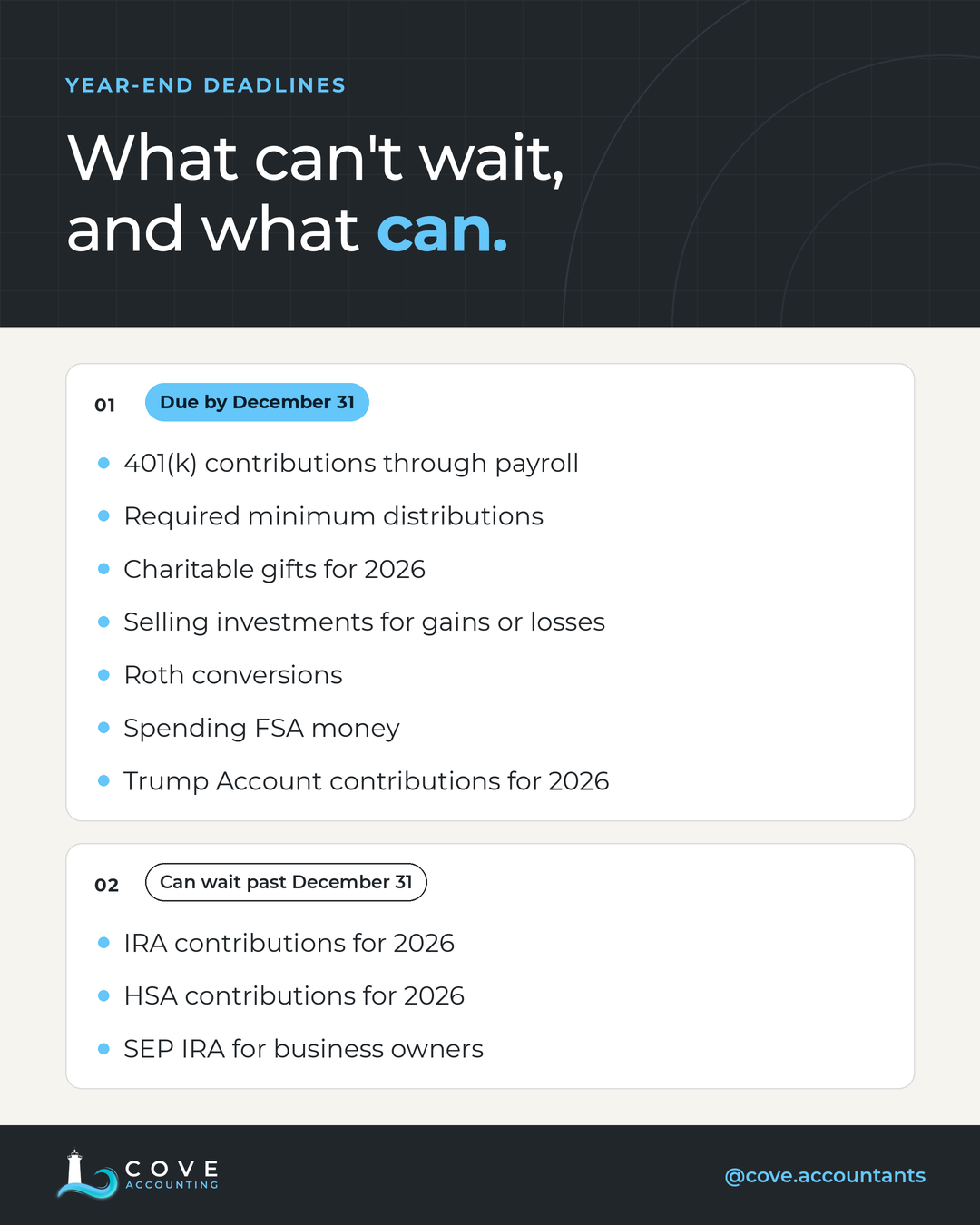
For business owners: Your November to-do listHow should a small business prepare for year-end?Business owners have more decisions to make and more deadlines to watch. November is the last full month before the holiday rush, so start now. - Set up a retirement plan. A retirement plan can be one of the larger tax benefits available to owners, and it helps with hiring and keeping good employees. A SEP IRA can generally be set up and funded as late as your business's tax return due date, including extensions. Other plans, like a Solo 401(k), have setup timing rules tied to year-end, so talk with us before December 31.
- Time big equipment purchases. Qualified property acquired after January 19, 2025 can qualify for 100% bonus depreciation, and the Section 179 expensing limit for 2026 is $2,560,000, phasing out above $4,090,000 of qualifying purchases, according to the IRS. Equipment must be placed in service (ready and available for use) by December 31 to count for 2026, so order early and buy only what the business needs.
- Plan year-end bonuses. Bonuses paid by December 31 are generally deductible this year. Decide this month so payroll can process them on time.
- Clean up the books. Reconcile bank and credit card accounts, follow up on unpaid invoices, and review debts you don't expect to collect.
- Get ready for 1099s. Collect W-9 forms from contractors now. For payments made in 2026, Form 1099-NEC is generally required when you pay a contractor $2,000 or more. It's due to contractors and the IRS by February 1, 2027, because January 31 falls on a Sunday.
- Check payroll for the new catch-up rule. Employees whose prior-year wages from you were over $150,000 must make 401(k) catch-up contributions as Roth contributions beginning in 2026. Confirm your payroll provider has this set up.
Frequently asked questionsWhen should I start year-end financial planning?+Now. Even in November, there are several weeks left to adjust withholding, retirement contributions, and charitable giving before the December 31 deadlines. Can I still contribute to an IRA after December 31?+Yes. IRA contributions for 2026 can be made until the April 2027 filing deadline, not including extensions, and HSA contributions follow a similar timeline. 401(k) contributions, however, must come out of a paycheck by December 31. What is the deadline for required minimum distributions?+If you're 73 or older, your annual RMD must generally be taken by December 31. The exception is your first RMD, which can be delayed until April 1 of the year after you turn 73. Can I deduct charitable donations if I don't itemize?+Beginning with tax year 2026, yes. If you take the standard deduction, you can deduct up to $1,000 ($2,000 if filing jointly) of cash gifts to qualifying charities. How much FSA money can I carry over into 2027?+If your employer's plan allows a carryover, the most you can carry from 2026 into 2027 is $680. Check your plan, because some plans offer a grace period instead and some offer neither. What should small business owners do before year-end?+Review whether to set up a retirement plan, time equipment purchases, decide on bonuses, reconcile the books, and collect W-9s from contractors so 1099s can go out by February 1, 2027. Get your year-end plan in placeYear-end planning doesn't have to be stressful. A short review this month can help you avoid surprises in April and set you up for a stronger 2027. Cove Accounting helps individuals, families, and business owners with retirement accounts, financial plans, and tax-smart year-end moves. Sources |


